
For most Jacksonville homes built on a concrete slab, luxury vinyl plank (LVP) and porcelain or ceramic tile are the safest choices, and engineered hardwood is the wood option that holds up. What matters even more than the material is the slab itself: a moisture reading within the flooring maker’s limit, a flat surface and the right underlayment decide whether the floor lasts. We sell and install flooring in Jacksonville, St. Johns and Duval counties, and this guide walks you through the choice and the slab checks in plain terms.
A concrete slab is not a dry, inert surface. It holds water from when it was poured, and it can draw ground moisture upward for years. A floor laid on top traps that moisture, and what happens next depends on the material: adhesive lets go, planks cup, carpet pads mildew, grout lines stain.
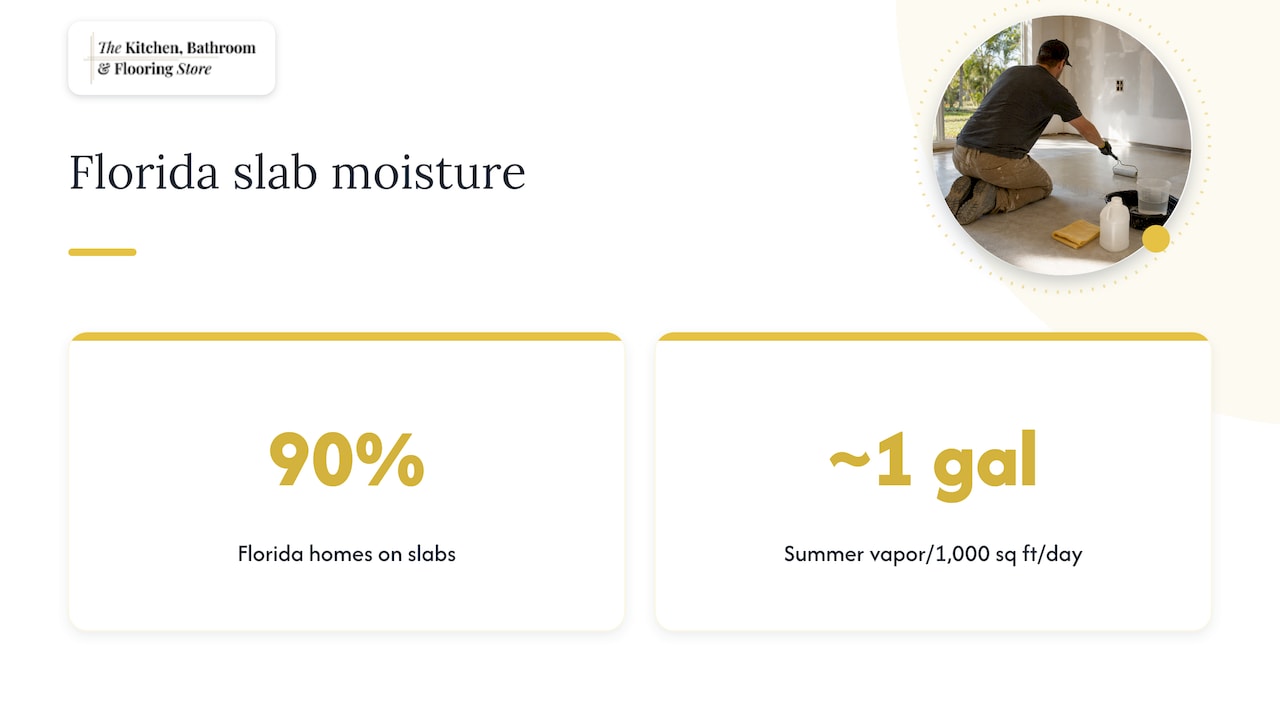
This matters more in Florida than in most states. BuildPriced, a cost-data site, reports that roughly 90% of Florida homes are built on a slab with no basement, and that slabs can pass a gallon or so of water vapor per 1,000 square feet per day in summer. Treat those figures as a general guide: your own slab’s readings are what count.
A trade-press feature from November 2026 makes the same point from the installer’s side. A TotalWorx marketing manager told Floor Covering News that many installation failures trace to the subfloor and moisture, not to the flooring product, and that following manufacturer guidelines is the best way to avoid callbacks.
Here is how the main choices behave on a slab in a humid climate. Lifespans are general ranges and depend on preparation and use.
| Flooring | Moisture tolerance on a slab | Comfort underfoot | Best for |
|---|---|---|---|
| Luxury vinyl plank (LVP) | Very good; look for waterproof construction | Good, better with underlayment | Whole-house runs, kitchens, baths, busy families |
| Porcelain or ceramic tile | Very good | Hard and cool | Kitchens, baths, entries, wet areas |
| Engineered hardwood | Moderate; needs a vapor barrier and acclimation | Warm and quiet | Living areas and bedrooms where you want real wood |
| Laminate | Moderate; edges swell if water gets in | Good with underlayment | Dry rooms on a budget |
| Carpet | Weakest; needs the barrier done right | Softest | Bedrooms and family rooms |
| Solid hardwood | Poor on a slab in Florida humidity | Warm | Rarely the right call here |
LVP is the favorite for slabs because it is made to tolerate moisture, clicks together as a floating floor and looks like wood or stone. A floating floor is not glued to the slab. The planks lock to each other and rest on an underlayment, so small slab irregularities and seasonal movement do not tear the floor apart. Most manufacturers still set a moisture limit, so a waterproof plank does not make a wet slab acceptable. See our luxury vinyl plank selection for the styles we carry, and our guide to waterproof flooring room by room if you are deciding between kitchens, baths and laundry rooms.
Tile is the standard answer for areas that may see standing water. It is rigid, so it needs a flat slab and sometimes a crack-isolation membrane over existing cracks, but it handles humidity and spills better than almost anything. It feels cold, which is a plus for many Florida households. Our Jacksonville tile cost and contractor checklist covers what drives the price.

Engineered hardwood has a real wood top layer over a layered core, which makes it more stable than solid planks. Over a slab, it needs a vapor barrier and time to adjust to your home’s air before installation. BuildPriced notes the National Wood Flooring Association’s 48-hour minimum, with 3 to 7 days of in-home acclimation common in Florida. Browse our hardwood flooring if you want the look of wood and are ready for the extra preparation.
Laminate is a budget-friendly, easy-to-install floor with a photographic wood or stone layer over a fiberboard core. That core is why water at the seams causes swelling. It suits dry rooms with a controlled slab. See our laminate flooring options.
Carpet is the most comfortable surface, but a pad without an effective vapor barrier beneath can hold moisture and mildew. With a tested slab and a correct moisture barrier it remains a good choice for bedrooms. Our carpet selection includes options for families who want softness.
Sealing or coating the slab itself leaves a hard, cold, low-maintenance surface. Coatings are sensitive to slab conditions, so the same moisture testing applies. Most homeowners who ask us about slabs want a finished floor with the warmth and style of LVP, wood or tile, so that is where this guide focuses.
The industry sets the rules, and they are not complicated once you know the terms.
ASTM International is the standards body whose test methods flooring manufacturers refer to. Its standard practice for preparing concrete floors, ASTM F710, calls for a permanent, effective moisture vapor retarder under on-grade and below-grade slabs and says all slabs should be tested for moisture regardless of age or grade level.
Two tests dominate:
The pass numbers come from the flooring manufacturer. IFTI reports typical resilient-flooring ceilings of 75 to 80% RH, with vapor emission limits around 3 to 5 pounds per 1,000 square feet per 24 hours, and a little higher only for products designated moisture-tolerant on the data sheet. Installing above the published limit is likely to void the product warranty. So the number that matters is the one in your chosen floor’s installation instructions.
Ask for the readings in writing. Floor Covering News quotes a Lignomat USA technical director saying moisture content and RH should be documented at installation as evidence if problems appear later.
The same trade article advises considering slab age and location. High readings on older slabs, especially at or below grade, can signal a continuing problem, and sealers, curing compounds or bond breakers left on the surface can affect how flooring bonds. Tell your installer anything you know about the slab, including past leaks or flooding.
Highly alkaline slabs can attack adhesives. ASTM F710 also directs that floors be tested for pH before resilient flooring goes down. Some manufacturers specify a pH range of roughly 7 to 9, so check the product sheet.
Shaw Industries’ installation guidance for a floating hard-surface floor asks for concrete that is clean, flat, dry and structurally sound, flat to within 1/8 inch over 6 feet or 3/16 inch over 10 feet. Hold a straightedge on the slab and any visible gap shows a low spot. Those low spots flex under planks and cause clicking, gapping and broken locking edges.
ASTM F710 says cracks, grooves, depressions and control joints should be filled or smoothed with latex patching or a recommended underlayment compound, and the surface cleaned by scraping, brushing or vacuuming. Dust and old adhesive are common reasons new floors fail to bond.
A high reading does not mean you cannot have the floor you want. It means the slab needs treatment first. The EFC moisture guide lists four approaches: reactive penetrants, moisture-retarding coatings, epoxy-based overlays and fiber-mat membrane systems. Which one fits depends on how high the readings are and on what the flooring maker accepts.
It also helps to understand where the moisture comes from. Water sitting around a foundation, poor drainage and leaks all feed a slab, and that is the same story behind damp-house problems generally. This overview of mold mitigation strategies explains how moisture control keeps spores from taking hold, and the principle applies under a floor as well.
Do not install over a slab with standing water or hydrostatic pressure, which is water pushed up through the concrete. Shaw’s guidance warns against that condition. Fix the water source first.
Underlayment is the thin layer between slab and floor. For floating LVP and laminate it adds cushion and sound dampening, and many versions include an attached vapor barrier. For engineered wood and carpet, the barrier is not optional: ASTM F710 calls for an effective vapor retarder under floors on or below grade. A common method for borderline floating floors is polyethylene sheeting with taped seams, but follow your flooring maker’s instructions, because the wrong layer can void a warranty.
If you are comparing indoor air quality across products, our guide to low-VOC flooring options explains how to read the labels.
The material is only part of the price. On a slab, the total moves with:
Any quote should state what preparation it includes. A bid that skips slab work can look cheaper and cost more later. Our Jacksonville flooring installation cost guide walks through moisture steps and what to look for in a bid.
Most flooring problems we hear about did not start with the flooring. They started under it. A beautiful plank laid over a slab nobody checked is a gamble, and in Florida’s humidity that gamble goes wrong more often than people expect.
That is why we think of a flooring job as a system, from the slab up: the right product for the room, the right underlayment, and an installation that follows the manufacturer’s instructions. When design, product selection and installation sit under one roof, one team is responsible for how all of it fits together, and you are not left coordinating separate contractors who each point at the other when something goes wrong.
Our advice is simple. Pick the floor for how you live, whether that means waterproof LVP for a busy family or tile for a kitchen, and let the slab conditions confirm the choice. Keep your moisture readings and product documents. They protect your warranty.
Anna
If you are planning a new floor on a slab in Jacksonville, St. Johns or Duval County, we handle the process from design help and product selection through professional installation, so you deal with one local showroom instead of several contractors. We also offer financing through monthly payment plans and packages tailored to your budget.
Start on our Flooring & Installation page to see what we carry and ask for an estimate for your home.
For most homes, luxury vinyl plank is the best all-around choice, since it tolerates moisture, feels comfortable with underlayment and comes in wood and stone looks. Porcelain or ceramic tile is the top pick for kitchens, baths and entries. Engineered hardwood is the wood option that suits Florida, with a vapor barrier and acclimation.
Yes. ASTM F710 says all slabs should be tested for moisture regardless of age or grade level. An older slab can still carry moisture, particularly at or below grade, and the reading needs to fall within your flooring manufacturer’s limit.
Engineered hardwood can go over a properly prepared slab with a vapor barrier and several days of acclimation. Solid hardwood reacts strongly to Florida humidity and is rarely the right match for a slab. Our hardwood flooring page shows what we offer.
Usually yes for floating LVP, unless the planks have a pad attached. Underlayment cushions the floor, reduces noise and can add a moisture barrier. Always follow the manufacturer’s installation sheet so the warranty stays valid.
Cracks and depressions should be filled or smoothed with a patching or underlayment compound before installation, and the surface should be flat within the manufacturer’s tolerance. Tile may also need a crack-isolation layer. Fixing these first prevents gaps, clicking and loose tiles.